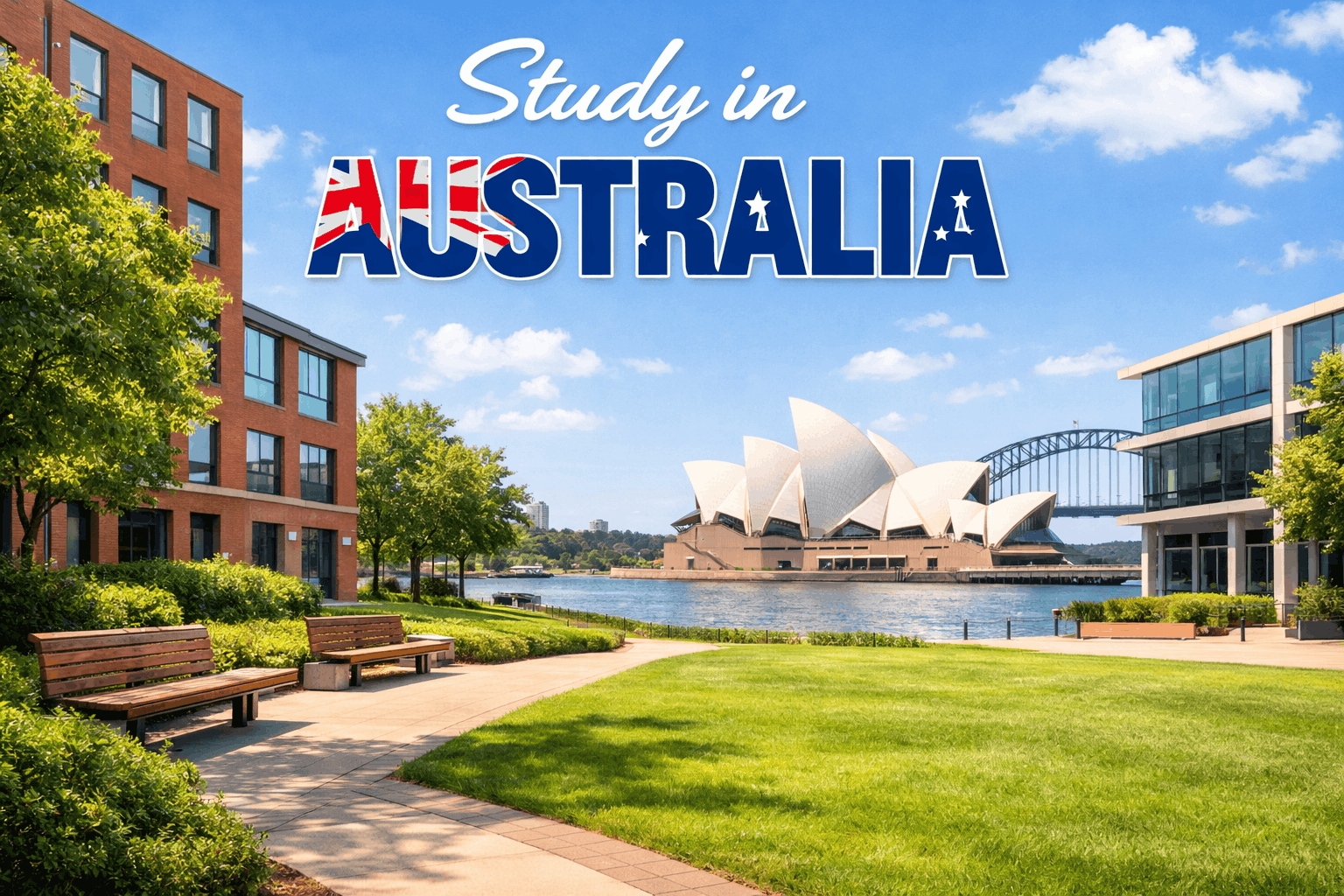
Study in Australia
Table of Contents
Australia continues to be one of the most chosen study destinations for international students, and the reasons are fairly straightforward. The universities are globally ranked, the education system is well-regulated, and the country has a strong job market across technology, healthcare, engineering, business, and finance. English is the medium of instruction throughout, which removes one common barrier for Indian students.
What also works in Australia's favour is structure. The student visa process is clear, work rights during study are defined, and post-study work visas give graduates time to build a career rather than leave immediately. For Indian students weighing options, Study in Australia offers a combination of academic credibility and practical outcomes that is hard to match.
Key Highlights of Study in Australia:
Key Point | Details |
Top Universities | University of Melbourne, ANU, University of Sydney |
Main Intakes | February and July |
Popular Courses | Business, IT, engineering, healthcare, data |
Tuition Fees | AUD 20,000–AUD 50,000/year (approx. Rs. 11.1L–Rs. 27.75L/year) |
Living Cost | AUD 20,000–AUD 27,000/year (approx. Rs. 11.1L–Rs. 15L/year) |
Visa Funds Required | AUD 24,505/year (approx. Rs. 13.6L) for Student Visa Subclass 500 |
Part-Time Work | 48 hours/fortnight during term time |
Holiday Work | Unlimited hours during scheduled breaks |
Post-Study Work Visa | 2 to 6 years based on qualification and location |
Destination Australia Scholarship | AUD 15,000/year (approx. Rs. 8.33L/year) for regional study support |
Top Universities in Australia
Australia has a strong university system anchored by the Group of Eight, a coalition of research-intensive institutions that consistently rank among the best globally. Outside this group, there are several universities offering strong vocational and industry-linked programs.
Location matters when choosing a university. Sydney and Melbourne are expensive cities; Adelaide, Brisbane, and Perth offer comparable academic quality at lower living costs.
University | QS World Ranking 2026 | Approx. Annual Tuition |
University of Melbourne | #13 | AUD 33,000–AUD 46,000 (approx. INR 18.3L–INR 25.5L) |
Australian National University | #30 | AUD 30,000–AUD 45,000 (approx. INR 16.65L–INR 24.97L) |
University of Sydney | #18 | AUD 32,000–AUD 48,000 (approx. INR 17.76L–INR 26.64L) |
University of Queensland | #40 | AUD 29,000–AUD 44,000 (approx. INR 16.1L–INR 24.42L) |
Monash University | #37 | AUD 30,000–AUD 46,000 (approx. INR 16.65L–INR 25.53L) |
University of New South Wales | #19 | AUD 32,000–AUD 48,000 (approx. INR 17.76L–INR 26.64L) |
University of Adelaide | #74 | AUD 27,000–AUD 42,000 (approx. INR 14.99L–INR 23.31L) |
University of Western Australia | #72 | AUD 27,000–AUD 42,000 (approx. INR 14.99L–INR 23.31L) |
Best Courses to Study in Australia
Australia's strongest course areas reflect its economy. Technology, healthcare, engineering, business, and education are all well-supported by both industry demand and government investment. The right course depends on your academic background, career direction, and budget.
1. Business and Management Courses
Business programs in Australia attract a large number of international students. The MBA in Australia is suited to working professionals; MSc programs in management, finance, and analytics work well for recent graduates. Several Australian business schools hold international accreditation, which adds weight to the degree globally.
Course | Suitable For | Approx. Annual Fees |
MBA | Experienced professionals | AUD 30,000–AUD 60,000 (approx. INR 16.65L–INR 33.3L) |
MSc Management | Fresh graduates | AUD 25,000–AUD 45,000 (approx. INR 13.88L–INR 24.97L) |
Business Analytics | Analytical backgrounds | AUD 28,000–AUD 45,000 (approx. INR 15.54L–INR 24.97L) |
Finance | Commerce and economics students | AUD 25,000–AUD 45,000 (approx. INR 13.88L–INR 24.97L) |
International Business | Business graduates | AUD 24,000–AUD 40,000 (approx. INR 13.32L–INR 22.2L) |
2. Computer Science and IT Courses
Australia's technology sector has grown steadily, with cities like Sydney and Melbourne developing strong startup and enterprise technology ecosystems. Degrees in computer science, data science, cybersecurity, artificial intelligence, and software engineering are in demand both locally and internationally.
Course | Suitable For | Approx. Annual Fees |
Computer Science | Coding-focused students | AUD 28,000–AUD 48,000 (approx. INR 15.54L–INR 26.64L) |
Data Science | Maths and tech backgrounds | AUD 28,000–AUD 45,000 (approx. INR 15.54L–INR 24.97L) |
Cybersecurity | IT and network learners | AUD 28,000–AUD 46,000 (approx. INR 15.54L–INR 25.53L) |
Artificial Intelligence | Tech and research students | AUD 30,000–AUD 48,000 (approx. INR 16.65L–INR 26.64L) |
Software Engineering | Programming-focused students | AUD 28,000–AUD 46,000 (approx. INR 15.54L–INR 25.53L) |
3. Healthcare, Science, and Engineering Courses
Australia has a well-funded healthcare and life sciences sector. Nursing, pharmacy, biomedical science, and public health are among the more practical choices. Engineering programs, particularly in mining, civil, mechanical, and environmental fields, are well-supported given Australia's resource-driven economy.
Course | Suitable For | Approx. Annual Fees |
Nursing | Healthcare and science students | AUD 25,000–AUD 35,000 (approx. INR 13.88L–INR 19.43L) |
Pharmacy | Science and chemistry backgrounds | AUD 30,000–AUD 45,000 (approx. INR 16.65L–INR 24.97L) |
Biomedical Science | Biology and medical students | AUD 28,000–AUD 42,000 (approx. INR 15.54L–INR 23.31L) |
Civil Engineering | Engineering graduates | AUD 28,000–AUD 45,000 (approx. INR 15.54L–INR 24.97L) |
Environmental Science | Science backgrounds | AUD 25,000–AUD 40,000 (approx. INR 13.88L–INR 22.2L) |
How to Apply to Study in Australia
The application process for Australian universities is straightforward but time-sensitive. Most institutions accept direct applications through their official portals. Starting 9 to 12 months before your intended intake is advisable, particularly if you need time for scholarships, education loans, and visa preparation.
Step | What to Do | Tip |
Choose a Course | Select based on career goals and market demand | Compare curriculum and graduate outcomes |
Shortlist Universities | Check fees, ranking, location, scholarships | Keep safe, match, and ambitious options |
Check Eligibility | Review academic marks, English scores, experience | Requirements vary by course and level |
Prepare Documents | SOP, LORs, transcripts, CV, passport | Begin at least 6 months before deadline |
Apply Online | Submit through university portals | Track each deadline separately |
Arrange Funds | Plan tuition, living costs, and visa funds | Keep INR buffer for exchange fluctuation |
Apply for Student Visa | Subclass 500 via ImmiAccount | Follow Department of Home Affairs guidelines |
Study in Australia Cost
Study in Australia cost includes tuition fees, accommodation, food, transport, health insurance through OSHC, books, visa application fees, and personal expenses. The total varies significantly by city, university, course, and lifestyle. Sydney and Melbourne are the most expensive; Adelaide, Perth, and Brisbane offer more manageable living costs.
H3: Tuition Fees in Australia
Tuition fees depend on the institution, course level, and field of study. Medicine and dentistry are at the higher end. Business, IT, and engineering postgraduate programs fall in the mid-range.
Level or Course Type | Approx. Annual Tuition | INR Value |
Undergraduate Programs | AUD 20,000–AUD 40,000/year | INR 11.1L–INR 22.2L/year |
Postgraduate Programs | AUD 22,000–AUD 50,000/year | INR 12.21L–INR 27.75L/year |
MBA and Business Programs | AUD 30,000–AUD 60,000/year | INR 16.65L–INR 33.3L/year |
Science and Engineering | AUD 28,000–AUD 48,000/year | INR 15.54L–INR 26.64L/year |
Medicine and Dentistry | AUD 55,000–AUD 75,000/year | INR 30.53L–INR 41.63L+/year |
Cost of Living in Australia
According to the Department of Home Affairs Australia, the estimated living cost used for student visa purposes is AUD 24,505 per year for a student. This figure is used when assessing financial capacity during the visa application.
Expense | Approx. Monthly Cost | INR Value |
Accommodation | AUD 800–AUD 2,000/month | INR 44,400–INR 1.11L/month |
Food and Groceries | AUD 400–AUD 600/month | INR 22,200–INR 33,300/month |
Transport | AUD 100–AUD 200/month | INR 5,550–INR 11,100/month |
Utilities and Internet | AUD 100–AUD 200/month | INR 5,550–INR 11,100/month |
OSHC Health Insurance | AUD 500–AUD 700/year | INR 27,750–INR 38,850/year |
Books and Personal Expenses | AUD 100–AUD 300/month | INR 5,550–INR 16,650/month |
Total Living Cost | AUD 20,000–AUD 27,000/year | INR 11.1L–INR 15L/year |
Top Scholarships to Study in Australia
Several scholarship options are available for international and Indian students. Government-funded awards like the Australia Awards are highly competitive but cover full costs. University-level scholarships are more accessible and often based on academic merit.
Scholarship | Coverage | Approx. Value |
Australia Awards Scholarships | Full tuition, living allowance, return airfare | Full funding |
Destination Australia Scholarship | Regional study support | AUD 15,000/year (approx. INR 8.33L/year) |
University Merit Scholarships | Partial tuition support | Varies by university |
Research Training Program (RTP) | PhD and research master's funding | Tuition plus stipend |
Endeavour Leadership Program | Study, research, professional development | Varies by category |
Australia Student Visa Requirements
Indian students need a Student Visa Subclass 500 to Study in Australia. The application is completed online through ImmiAccount. Key requirements include a Confirmation of Enrolment from a registered Australian institution, proof of financial capacity, English test scores, and Overseas Student Health Cover.
Requirement | Detail | Approx. Amount |
Confirmation of Enrolment (CoE) | From a CRICOS-registered institution | Required |
Proof of Financial Capacity | Living, tuition, and travel costs | AUD 24,505/year (approx. INR 13.6L) |
OSHC Health Insurance | Mandatory for the full visa duration | AUD 500–AUD 700/year |
English Test Scores | IELTS, TOEFL, PTE, or accepted equivalent | University and course specific |
Genuine Student Requirement | Statement of purpose and study plan | Required |
Academic Documents | Transcripts, marksheets, certificates | Required |
Visa Application Fee | Paid online via ImmiAccount | AUD 710 (approx. INR 39,405) |
Work Opportunities While Studying in Australia
International students on a Student Visa Subclass 500 can work up to 48 hours per fortnight during the academic term. During scheduled course breaks, there is no restriction on hou/INR This work right helps students manage personal expenses and build local experience.
Role | Work Limit | Approx. Hourly Rate |
Retail Assistant | 48 hours/fortnight during term | AUD 24–AUD 28/hour (approx. INR 1,332–INR 1,554/hour) |
Hospitality Assistant | 48 hours/fortnight during term | AUD 24–AUD 30/hour (approx. INR 1,332–INR 1,665/hour) |
Campus or Admin Support | 48 hours/fortnight during term | AUD 24–AUD 28/hour (approx. INR 1,332–INR 1,554/hour) |
Tutoring Assistant | 48 hours/fortnight during term | AUD 30–AUD 50/hour (approx. INR 1,665–INR 2,775/hour) |
Student Ambassador | 48 hours/fortnight during term | AUD 24–AUD 30/hour (approx. INR 1,332–INR 1,665/hour) |
Post-Study Work Opportunities in Australia
The Temporary Graduate Visa Subclass 485 allows eligible international graduates to live and work in Australia after completing their degree. The duration depends on qualification level and the location where the degree was studied. Regional study can extend the visa period considerably.
Job Role | Field | Approx. Annual Salary |
Software Developer | Computer science, IT, software engineering | AUD 80,000–AUD 110,000/year (approx. INR 44.4L–INR 61.05L) |
Data Analyst | Data science, analytics, IT | AUD 75,000–AUD 100,000/year (approx. INR 41.63L–INR 55.5L) |
Business Analyst | Business, management, finance | AUD 75,000–AUD 105,000/year (approx. INR 41.63L–INR 58.28L) |
Civil or Mechanical Engineer | Engineering | AUD 75,000–AUD 105,000/year (approx. INR 41.63L–INR 58.28L) |
Registered Nurse | Healthcare | AUD 70,000–AUD 95,000/year (approx. INR 38.85L–INR 52.73L) |
Finance Associate | Finance, accounting, banking | AUD 70,000–AUD 100,000/year (approx. INR 38.85L–INR 55.5L) |
Post-Study Visa Stay Back Options:
Qualification and Location | Stay-Back Duration | Purpose |
Bachelor Degree (major city) | 2 years | Seek graduate-level employment |
Master by Coursework (major city) | 3 years | Longer stay for postgraduate graduates |
Master by Research or PhD | 4 years | Research graduate pathway |
Regional Study (any level) | Additional 1 to 2 years | Incentive for studying outside major cities |
Visa Application Fee | AUD 1,895 (approx. INR 1.05L) | Paid at time of application |
Conclusion
Study in Australia offers Indian students a well-structured path from enrolment to employment. Academic quality is strong across business, technology, healthcare, engineering, and science. Post-study work rights are among the more generous globally, and the country's immigration framework is transparent and relatively predictable.
The cost of Study in Australia for Indian students includes tuition of around AUD 20,000–AUD 50,000 per year (approx. INR 11.1L–INR 27.75L per year) and living expenses of around AUD 20,000–AUD 27,000 per year (approx. INR 11.1L–INR 15L per year). Planning finances early, exploring scholarships, and considering regional universities can all reduce the total cost meaningfully.
Planning to study in Australia? Speak with our study abroad experts for personalised guidance.
Popular Study Abroad Programs from Top Universities: