Study in Singapore
Table of Contents
- Why Study in Singapore?
- Top Universities to Study in Singapore
- Popular Courses to Study in Singapore
- Course Structure of Programmes in Singapore
- Eligibility and Admission Requirements to Study in Singapore
- Tuition Fees to Study in Singapore
- Cost of Living in Singapore for International Students
- Top Scholarships to Study in Singapore
- Intakes and Application Timeline to Study in Singapore
- How to Apply to Study in Singapore
- Student Visa Requirements to Study in Singapore
- Top Cities to Study in Singapore
- Top Job Opportunities After Studying in Singapore
- Conclusion
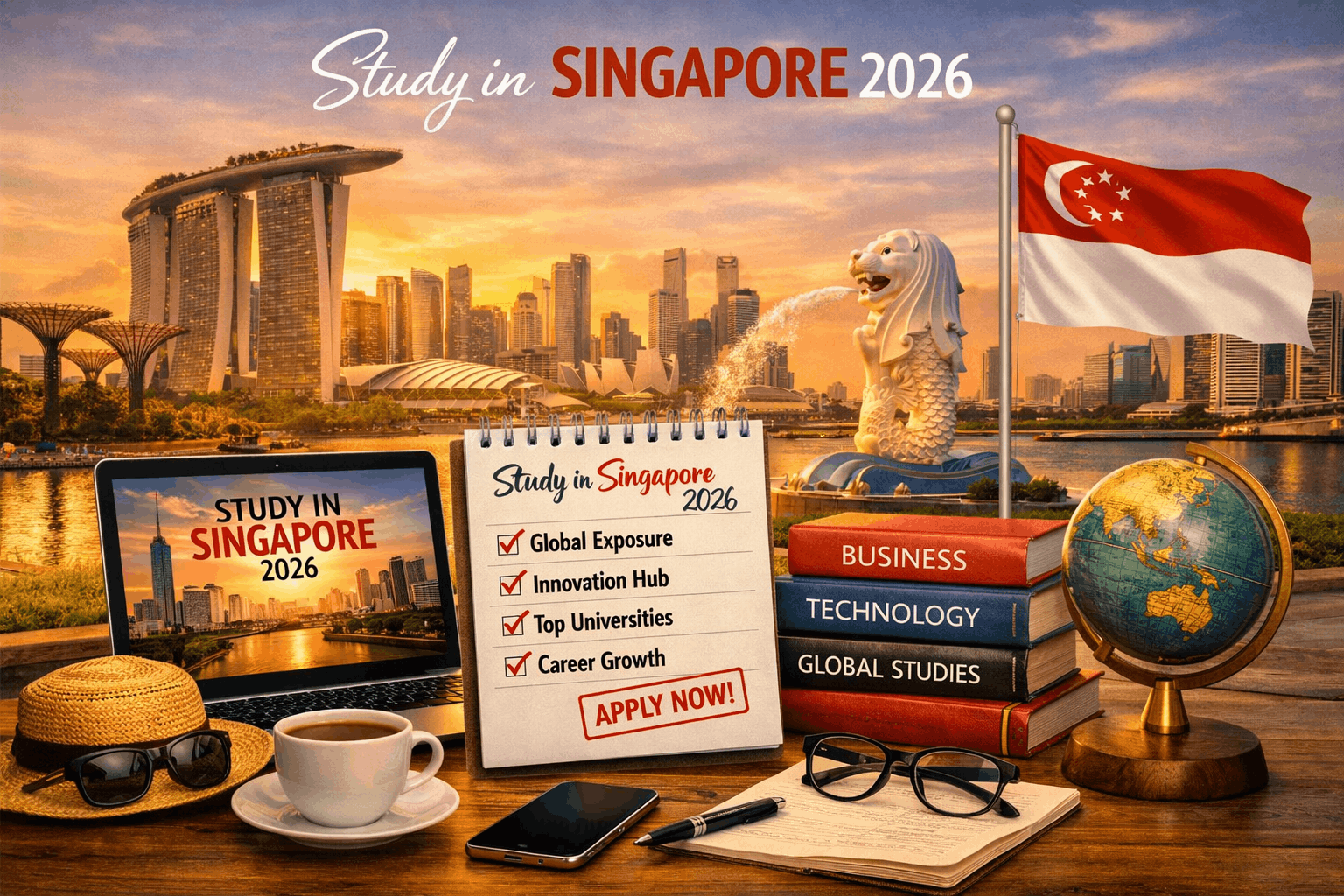
Study in Singapore has become an increasingly popular choice for international students seeking world-class education and global career opportunities. The country is home to some of the world's top-ranked universities, with NUS and NTU consistently featuring among the best institutions globally. With English as the primary language of instruction, a reputation as one of the safest countries in the world, and a thriving economy driven by technology, finance, biomedical sciences, and logistics, Singapore offers an ideal environment for higher education. For students looking to study in Singapore, the combination of academic excellence, strong industry connections, and a multicultural learning experience makes it one of Asia's most attractive study destinations.
Key Highlights: Study in Singapore for International Students
Key Highlights | Details |
Medium of Instruction | English |
Top Universities | NUS (#8 globally), NTU (#12 globally), SMU, SUTD, SIT, SUSS |
Undergraduate Tuition Fees | SGD 17,000–40,000 (INR 10.3L–24.2L) per year |
Postgraduate Tuition Fees | SGD 20,000–55,000 (INR 12.1L–33.3L) per year |
Student Visa Type | Student's Pass (issued by ICA via SOLAR system) |
Part-Time Work Rights | 16 hours/week during term; full-time in June, July, and August |
Post-Study Work | Employment Pass or S Pass (no automatic post-study visa; direct transition to work pass) |
MOE Tuition Grant | 50–70% tuition subsidy; requires 3-year work bond in Singapore |
Cost of Living | SGD 1,200–2,500 (INR 72.7K–1.51L) per month |
Main Intake | August; some programmes offer January entry |
Popular Fields | Computer Science, Data Science, Engineering, Business, Life Sciences, Law, Finance |
Why Study in Singapore?
There are practical, academic, and career-driven reasons to choose Singapore. Here is what makes it stand out from other study destinations in Asia and beyond.
Globally Ranked Universities: NUS holds a 95.9 QS score with near-perfect marks in academic reputation (99.9) and international faculty ratio (100). NTU scores 93.7, excelling in faculty-to-student ratio and research citations per faculty. Together, they anchor Singapore as Asia's leading higher education hub.
English as the Language of Teaching: Every degree at Singapore's six autonomous universities is taught in English. For most international students, particularly those from India, this removes any language barrier and ensures qualifications are transferable to global job markets without additional certification.
One of the Highest Graduate Employment Rates in the World: Singapore's universities consistently deliver 95 percent or higher graduate employment rates. Computing graduates earn a median starting salary of SGD 6,500 (INR 3.94L) per month, while law and medicine graduates are not far behind, according to the Joint Autonomous Universities Graduate Employment Survey (JAUGES).
Direct Access to Major Employers: Hundreds of multinationals, including Google, Apple, Meta, JPMorgan, Goldman Sachs, Pfizer, and Shell, run their Asia-Pacific operations from Singapore. Campus recruitment is well-established and graduate hiring pipelines are active across all major sectors.
Government Tuition Subsidy: The MOE Tuition Grant reduces annual tuition by 50 to 70 percent for eligible international students at all six autonomous universities, making a world-class degree significantly more affordable than comparable programmes in the US, UK, or Australia.
Safety and Quality of Life: Singapore consistently places among the top three safest cities in the world. Healthcare is excellent, public transport is efficient and affordable, and the food culture, particularly at hawker centres, keeps day-to-day living costs well within a student budget.
Regional Career Springboard: With direct flight connections to every major city in Southeast Asia, Northeast Asia, and South Asia, Singapore positions graduates at the centre of one of the world's most economically dynamic regions.
Top Universities to Study in Singapore
Each of Singapore's six publicly funded autonomous universities has a distinct academic identity. NUS and NTU lead globally, while the remaining four hold strong positions in their respective specialist areas.
Top Universities in Singapore for International Students:
University | QS World Ranking 2026 | Known For |
National University of Singapore (NUS) | #8 | Computer Science, Medicine, Law, Engineering, Business, Life Sciences |
Nanyang Technological University (NTU) | #12 | Materials Science, AI, Engineering, Business, Communication, Data Science |
Singapore Management University (SMU) | #511 | Business, Finance, Law, Accountancy, Information Systems |
Singapore University of Technology and Design (SUTD) | #519 | Design-Engineering, Architecture, Computer Science, Innovation |
Singapore Institute of Technology (SIT) | - | Applied Engineering, Health Sciences, ICT, Business |
Singapore University of Social Sciences (SUSS) | - | Social Services, Law, Business, Accountancy, Education |
A few subject-level highlights worth noting:
NTU holds 11 disciplines in the global top 10 including Materials Sciences (#2), Communication and Media Studies (#4), and Data Science (#5).
NUS ranks third globally in Social Policy and Administration and places in the top 10 globally for Computer Science, Dentistry, and Anatomy and Physiology.
SMU is Singapore's top-ranked institution for business and finance programmes and is actively targeting a top 50 global business school position.
Popular Courses to Study in Singapore
Singapore's universities cover a wide range of disciplines at undergraduate and postgraduate level, with particular depth in STEM, business, law, and life sciences. All programmes across the six autonomous universities are delivered entirely in English.
Most Popular Courses to Study in Singapore:
Field of Study | Popular Programmes |
Computer Science and AI | BSc/MSc Computer Science, MSc Artificial Intelligence, MSc Data Science and ML |
Engineering | BEng/MEng Electrical, Mechanical, Civil, Chemical, Aerospace, Biomedical Engineering |
Business and Management | BBA, MBA, MSc Finance, MSc Business Analytics, MSc Supply Chain Management |
Life Sciences | BSc/MSc Biomedical Science, Pharmacy, Biotechnology, Molecular Biology |
Data Science and Analytics | MSc Data Science, MSc Business Analytics, MSc Applied Statistics |
Law | LLB, LLM International Law, LLM Corporate and Financial Law |
Finance and Accountancy | BSc Accountancy, MSc Finance, MSc Quantitative Finance |
Information Systems | BSc Information Systems, MSc Information Systems Management, MSc Cybersecurity |
Among these, computing graduates earn the highest median starting salary at SGD 6,500 (INR 3.94L) monthly, followed by law at SGD 6,000 (INR 3.64L) and medicine at SGD 6,300 (INR 3.82L), based on data from Singapore's autonomous university graduate employment surveys.
Course Structure of Programmes in Singapore
Undergraduate degrees in Singapore run for three to four years, depending on the discipline, while most taught postgraduate programmes are completed in one to two years. NUS, NTU, and SMU all follow a semester-based academic calendar, with each academic year split into two semesters and an optional special term.
General Undergraduate Course Structure:
Year | Key Components |
Year 1 | Foundation modules, university-wide core requirements, introduction to major |
Year 2 | Core major modules, elective exploration, and academic and professional skills development |
Year 3 | Advanced major modules, research exposure, and internship where applicable |
Year 4 (where applicable) | Dissertation or industry capstone, specialisation electives, final assessments |
General Postgraduate Course Structure:
Stage | Key Components |
Core Modules | Advanced subject content, research methodology, analytical and technical frameworks |
Specialisation Track | Elective modules tailored to career direction or research area |
Applied Component | Industry project, internship, or applied research module depending on programme |
Thesis / Capstone | Independent research dissertation or structured industry-facing capstone project |
Top Specialisations to Study in Singapore
Singapore offers a wide range of industry-focused programs across technology, business, healthcare, and engineering. Some of the most popular specialisations include Artificial Intelligence, Data Science, Computer Science, Business Administration, Finance, Cybersecurity, Biotechnology, Supply Chain Management, Engineering, and Public Health. These fields align closely with Singapore's innovation-driven economy and offer strong career prospects for international graduates.
Specialisation | Universities Known For It |
Artificial Intelligence and Machine Learning | NUS, NTU, SUTD |
Quantitative Finance and Financial Technology | SMU, NUS Business School |
Biomedical Engineering and Life Sciences | NUS, NTU |
Data Science and Cybersecurity | NTU, NUS School of Computing |
Design and Engineering Innovation | SUTD |
International Business and Logistics | SMU, NUS, NTU |
Corporate and International Law | NUS Faculty of Law, SMU School of Law |
Eligibility and Admission Requirements to Study in Singapore
Admission requirements are broadly consistent across Singapore's autonomous universities, with the specific academic expectations varying by institution and programme level.
Undergraduate Admission Requirements
International students applying for undergraduate programs in Singapore must meet the academic requirements set by their chosen university. Admission standards vary by institution, with top universities placing greater emphasis on academic excellence and subject-specific performance.
University Tier | Academic Requirements |
NUS and NTU | Strong secondary school results equivalent to Singapore A-Levels; subject-specific requirements apply; admission is highly competitive |
SMU and SUTD | Recognised secondary qualification with strong academic standing; portfolio or aptitude assessment may apply at SUTD |
SIT and SUSS | Recognised polytechnic diploma or secondary school qualification; broader subject acceptance across most programmes |
Postgraduate Admission Requirements
For postgraduate admissions, applicants generally require a recognized bachelor's degree and a strong academic record. Some programs may also consider professional experience, particularly for management and executive-level courses.
University Tier | Academic Requirements |
NUS and NTU | Bachelor's degree with strong academic standing equivalent to a UK 2:1 or first-class honours; relevant subject background expected for most programmes |
SMU and SUTD | Bachelor's degree with good academic record; relevant professional experience valued for MBA and executive programmes |
SIT and SUSS | Recognised bachelor's degree; professional work experience may be considered alongside academic qualifications |
English Language Requirements
English is the sole medium of instruction at all Singapore autonomous universities. Most programmes waive the English proficiency test for students from countries where English is the primary medium of education.
University | IELTS Requirement | TOEFL iBT |
NUS | 6.0–7.0 depending on programme | 85–100 |
NTU | 6.0–6.5 depending on programme | 85–92 |
SMU | 6.5–7.0 depending on programme | 100+ |
SUTD | 6.5 minimum | 90 minimum |
Tuition Fees to Study in Singapore
The single most important financial decision for international students in Singapore is whether to accept the MOE Tuition Grant. Accepting it reduces annual tuition by 50 to 70 percent but requires a three-year commitment to work for a Singapore-registered employer after graduation.
Undergraduate Tuition Fees:
University | Approximate Annual Tuition Fees (International Students, with MOE Grant) |
NUS (Arts and Social Sciences, Science) | SGD 17,000–22,000 (INR 10.3L–13.3L) |
NUS (Engineering, Computing, Business) | SGD 22,000–32,000 (INR 13.3L–19.4L) |
NUS (Medicine, Law, Dentistry) | SGD 35,000–55,000 (INR 21.2L–33.3L) |
NTU (Engineering, Business, Science) | SGD 20,000–30,000 (INR 12.1L–18.2L) |
SMU (Business, Accountancy, Law, IT) | SGD 18,000–28,000 (INR 10.9L–16.9L) |
SUTD (Engineering, Architecture, Design) | SGD 18,000–22,000 (INR 10.9L–13.3L) |
Postgraduate Tuition Fees:
Programme Type | Approximate Annual Tuition Fees (International Students) |
MSc STEM (Engineering, Computing, Data Science) | SGD 25,000–45,000 (INR 15.1L–27.2L) |
MSc Business and Finance | SGD 30,000–50,000 (INR 18.2L–30.2L) |
MBA (NUS, NTU, SMU) | SGD 50,000–85,000 (INR 30.2L–51.5L) |
LLM (NUS Faculty of Law) | SGD 35,000–50,000 (INR 21.2L–30.2L) |
PhD (Government-subsidised) | SGD 8,000–15,000 (INR 4.8L–9.1L) per year |
Cost of Living in Singapore for International Students
Singapore is one of the more expensive cities in Asia, but student-specific options make day-to-day costs very manageable with the right approach. Campus hostels, hawker centres, and an efficient MRT network are the three things that most consistently keep student budgets under control.
Monthly costs for most international students fall between SGD 1,800 and SGD 2,800 (INR 1.09L–1.70L), with those living on-campus and eating at hawker centres sitting comfortably at the lower end of that range.
Estimated Monthly Living Cost Breakdown:
Expense Category | On-Campus / Budget (Monthly) | Off-Campus / Mid-Range (Monthly) |
Accommodation | SGD 400–700 (INR 24.2K–42.4K) | SGD 800–1,500 (INR 48.5K–90.9K) |
Food and Groceries | SGD 250–400 (INR 15.1K–24.2K) | SGD 400–700 (INR 24.2K–42.4K) |
Transport | SGD 80–120 (INR 4.8K–7.3K) | SGD 100–200 (INR 6.1K–12.1K) |
Health Insurance | SGD 50–100 (INR 3K–6.1K) | SGD 80–150 (INR 4.8K–9.1K) |
Personal and Miscellaneous | SGD 150–300 (INR 9.1K–18.2K) | SGD 200–400 (INR 12.1K–24.2K) |
Approximate Annual Living Cost:
On-Campus / Budget: SGD 12,000–18,000 (INR 7.3L–10.9L)
Off-Campus / Mid-Range: SGD 18,000–30,000 (INR 10.9L–18.2L)
Note: Singapore's hawker centres offer full meals for SGD 3 to SGD 6 (INR 182–364), which is one of the most practical advantages of student life in Singapore compared to other major global study cities.
Visa Financial Requirement: ICA requires proof of funds covering tuition and living costs. For living costs, the threshold is SGD 12,000 to SGD 15,000 (INR 7.3L–9.1L) per year, on top of tuition fees.
Top Scholarships to Study in Singapore
Singapore offers a range of scholarships for international students, including the Singapore International Graduate Award (SINGA), ASEAN Undergraduate Scholarship, NUS Global Merit Scholarship, NTU Scholarship, and SMU Scholarships. These awards can help cover tuition fees, living expenses, and other study-related costs, making it easier for students to pursue higher education in Singapore.
Scholarship | Eligibility | Coverage |
MOE Tuition Grant | International students at NUS, NTU, SMU, SUTD, SIT, or SUSS enrolled in full-time programmes; requires 3-year Singapore work bond post-graduation | 50–70% reduction on annual tuition fees |
ASEAN Undergraduate Scholarship | ASEAN country nationals; top 5–10% academic standing; applying to NUS, NTU, SMU, SUTD, SIT, or SUSS | Full tuition, annual allowance of SGD 5,800 (INR 3.5L), accommodation, return airfare; 3-year work bond |
Singapore International Graduate Award (SINGA) | International PhD applicants at NUS, NTU, SUTD, or A*STAR; open to all nationalities | Full tuition, monthly stipend SGD 2,700–3,100 (INR 1.64L–1.88L), one-time airfare |
NUS Research Scholarship | Research Master's or PhD applicants at NUS; merit-based | Full tuition waiver + monthly stipend SGD 2,200–3,200 (INR 1.33L–1.94L) |
NTU Research Scholarship | Research programme applicants at NTU; merit-based | Full tuition waiver + monthly stipend |
SMU Master's Scholarships | International postgraduate applicants at SMU; merit-based; reviewed at admission | Partial to full tuition fee reduction |
Intakes and Application Timeline to Study in Singapore
Singapore's universities run one primary intake each year in August, with a small number of postgraduate programmes offering January entry for students who miss the main cycle.
Intakes to Study in Singapore:
Intake | Programme Start | Application Timeline |
August (Main) | August | Applications open September–November (prior year); most deadlines December–March |
January (Limited) | January | Available at select graduate programmes; applications open July–September |
Key Points:
August is the main and most widely available intake across all programmes and all six autonomous universities.
Scholarship applications including the ASEAN Undergraduate Scholarship and SINGA have their own earlier deadlines, often closing in January or February. Students applying for scholarships must plan their timeline around these earlier dates rather than the standard admissions deadline.
On-campus hostel applications at NUS and NTU fill within days of offer letters being issued. Submit your accommodation application on the same day you receive your offer.
January entry is available at a limited number of postgraduate programmes only. Confirm availability directly with the department before planning for a mid-year start.
How to Apply to Study in Singapore
To study in Singapore, choose your preferred university and program, check eligibility requirements, prepare documents such as academic transcripts, English language test scores, SOP, and LORs, submit your application online, and apply for a student visa after receiving an admission offer.
Step | Stage | What You Need to Do |
Step 1 | Research and Shortlist | Compare universities and programmes based on QS ranking, course content, MOE Tuition Grant eligibility, fees, and career alignment |
Step 2 | Check Eligibility | Review grade requirements, English proficiency standards, and programme-specific prerequisites |
Step 3 | Prepare Documents | Gather transcripts, degree certificates, personal statement or SOP, two references, CV, and valid passport |
Step 4 | Submit Application | Apply directly through each university's official online admissions portal; pay applicable fees |
Step 5 | Accept Offer | Accept your conditional or unconditional offer and pay the enrolment deposit to confirm your place |
Step 6 | Apply for MOE Tuition Grant | If accepting the grant, sign the legal agreement and submit required documentation before enrolment |
Step 7 | Student's Pass Application | Your university submits the Student's Pass application to ICA through the SOLAR system on your behalf |
Step 8 | Receive IPA Letter | Collect the In-Principle Approval letter from ICA, which also functions as your entry visa if you require one |
Step 9 | Arrive and Complete Formalities | Travel to Singapore, complete the medical examination if required, and visit ICA to have your Student's Pass formally issued |
Student Visa Requirements to Study in Singapore
Every international student enrolled full-time at an approved Singapore institution must hold a Student's Pass, issued by the Immigration and Checkpoints Authority (ICA). Singapore does not issue a traditional student visa. The Student's Pass is the legal document that permits you to reside in Singapore for the full duration of your academic programme.
How the Student's Pass Process Works
Your institution manages the application through the SOLAR (Student's Pass On-Line Application and Registration) system. The pass is tied to your specific institution and programme. Transferring to a different university requires a new Student's Pass application.
If you withdraw from your programme, the pass is automatically invalidated and you must leave Singapore. Processing typically takes two to four weeks from submission to In-Principle Approval, placing it among the most efficient student immigration systems globally.
Eligibility Criteria:
Unconditional admission offer from a Singapore institution approved by ICA
Enrolment in a full-time programme at an autonomous or approved private institution
Valid passport with at least six months validity beyond the course end date
Proof of financial resources covering tuition fees and living costs
Mandatory medical examination within 30 days of arrival in Singapore, including TB screening
Financial Requirements:
ICA requires proof of funds covering both tuition and living costs. For living expenses, the threshold is SGD 12,000 to SGD 15,000 (INR 7.3L–9.1L) per year in addition to tuition. A security deposit of SGD 5,000 (INR 3.03L) via Banker's Guarantee or Cashier's Order may also be required for certain applicants.
Documents Required for Student's Pass:
Valid passport (minimum 6 months validity beyond course end date)
Recent passport-size photograph (white background, taken within 3 months)
Unconditional admission letter from the Singapore institution
Academic transcripts and degree or school-leaving certificates
Bank statements or financial documents covering tuition and SGD 12,000–15,000 living costs
Medical examination report where applicable
eForm 16 and eForm V36 submitted via the SOLAR platform
Student's Pass issuance fee of SGD 60 (INR 3,636) and Multiple Journey Visa fee of SGD 30 (INR 1,818) if required
Top Cities to Study in Singapore
Singapore is a compact, well-connected city-state where public transport links every major university to the central business district. That said, different areas carry distinct characteristics relevant to student life and proximity to key employers.
Area | Why It is Preferred |
Kent Ridge (NUS Campus) | NUS main campus; adjacent to one-north biomedical and tech cluster; Biopolis and Fusionopolis nearby |
Jurong East / Boon Lay | Close to NTU; growing industrial and tech corridor; most affordable residential options on the island |
City Hall / Bugis | SMU campus; heart of the Central Business District; walking distance from major banks and law firms |
Punggol / Changi | SIT's newer campus; emerging tech district; strong MRT connectivity to east coast employers |
Clementi / Buona Vista | Residential hub for NUS students; strong MRT links; closest to Kent Ridge campus |
One-North | Singapore's flagship science and tech cluster; headquarters for major biotech, pharma, and tech companies |
Top Job Opportunities After Studying in Singapore
Singapore's job market rewards graduates quickly, particularly those with technical and quantitative skills. The median gross monthly salary across all full-time employed Singapore residents is SGD 5,800 (INR 3.52L) per month including employer CPF contributions, according to the Ministry of Manpower. For fresh graduates from the autonomous universities, the median starting salary reached SGD 4,500 (INR 2.73L) per month in 2024, with computing and law graduates leading the field.
Top Job Roles and Approximate Salaries After Studying in Singapore:
Job Role | Approximate Monthly Salary | Approximate Annual Salary |
Software Engineer | SGD 5,500–9,000 (INR 3.33L–5.45L) | SGD 66,000–108,000 (INR 40L–65.5L) |
Data Scientist / AI Engineer | SGD 5,500–8,500 (INR 3.33L–5.15L) | SGD 66,000–102,000 (INR 40L–61.8L) |
Financial Analyst | SGD 4,500–7,000 (INR 2.73L–4.24L) | SGD 54,000–84,000 (INR 32.7L–50.9L) |
Biomedical / Pharmaceutical Researcher | SGD 4,500–7,500 (INR 2.73L–4.55L) | SGD 54,000–90,000 (INR 32.7L–54.5L) |
Business Analyst | SGD 4,000–6,500 (INR 2.42L–3.94L) | SGD 48,000–78,000 (INR 29.1L–47.3L) |
Cybersecurity Analyst | SGD 5,100–8,500 (INR 3.09L–5.15L) | SGD 61,200–102,000 (INR 37.1L–61.8L) |
Corporate Lawyer | SGD 6,000–10,000+ (INR 3.64L–6.06L+) | SGD 72,000–120,000+ (INR 43.6L–72.7L+) |
Management Consultant | SGD 5,000–9,000 (INR 3.03L–5.45L) | SGD 60,000–108,000 (INR 36.4L–65.5L) |
Conclusion
Few study destinations combine academic prestige, career access, and practical affordability the way Singapore does. With NUS at eighth and NTU at twelfth in the world, both anchoring Asia's top higher education rankings, the academic credentials speak clearly. The MOE Tuition Grant, scholarship ecosystem, and strong starting salaries across technology, finance, and life sciences reinforce the financial case. For international students planning to study in Singapore in 2026, the key is early action; scholarship windows close quickly, hostel places fill fast, and competitive programmes at NUS and NTU fill their cohorts well before official deadlines.
Planning to Study in Cyprus? Speak with our study abroad experts for personalised guidance.